
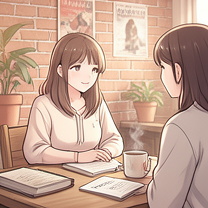
Conquering the Coffee Break: Small Talk in German
Okay, so here I am, a few months into living in Berlin, and honestly? I still feel like I’m constantly battling the awkwardness of small talk. It’s not that I don’t want to connect with people, it’s just… the words get tangled. Especially when I’m trying to make conversation during those precious class breaks. It’s completely different from just understanding the lectures, it’s about actually participating. I’ve realised that a huge part of learning German isn’t just about verbs and nouns; it’s about learning how to actually talk to people. And right now, the coffee break is my biggest challenge.
The Dreaded Silence (and My Initial Mistakes)
The first few times, I’d just stand there, nervously clutching my coffee, desperately trying to find something, anything, to say. I’d even attempted a slightly overly enthusiastic “Wie geht’s?” (How’s it going?) which, looking back, probably came across as incredibly intense. I quickly learned that just asking that question and waiting for an answer isn’t a conversation. People freeze. I think I was expecting some dramatic, enthusiastic response, which is just not how Germans do things!
I also made the classic mistake of trying to translate everything directly from English. Like, when someone asked me about my hometown, I blurted out, “Ich komme aus der United States von Amerika!” (I come from the United States of America!). It’s fine to say that, but it’s a bit… definitive. It felt like I was announcing my entire identity, and honestly, it was just a bit overwhelming for the other person.
Essential Phrases for the Break
So, let’s talk about some actually useful phrases. Here are a few that I’ve been practicing, and that seem to go down pretty well:
- “Na?” (Short for “Na, wie geht’s?”) – This is the go-to. It’s incredibly informal and versatile. You can use it with just about anyone. It’s like saying “So?” or “What’s up?”
- “Schönes Wetter, oder?” (Beautiful weather, isn’t it?) – Perfect for commenting on the weather, which is always a safe topic.
- “Was machst du so?” (What are you up to?) – A little more inquisitive, but still friendly.
- “Ich bin neu hier.” (I’m new here.) – If you want to explain your situation. It’s a good icebreaker.
- “Wie findest du die Vorlesung?” (How do you find the lecture?) – Only use if you are comfortable and want to show interest in the course.
Word Order and Short Conversations
German word order can be tricky, especially when you’re trying to build a simple sentence. It’s not always Subject-Verb-Object like English.
Here’s an example from a recent break:
- Me: “Na, wie geht’s?” (So, how’s it going?)
- Thomas (my classmate): “Mir geht’s gut, danke. Und dir?” (I’m doing well, thanks. And you?)
- Me: “Ganz gut. Ich bin neu hier, ich lerne Deutsch.” (Quite well. I’m new here, I’m learning German.) – Notice how I structured the sentence. It’s not a perfect example of grammatical perfection, but it works!
Another key thing I’ve noticed is that Germans often respond to questions with questions. It can feel a bit confusing at first, but it’s just their way of being polite and gauging your interest. It forces you to engage further.
Real-Life Scenarios and Learning from Mistakes
Last week, I was talking to a guy named Steven about his weekend. I wanted to ask him where he went, so I said, “Wo warst du am Wochenende?” (Where were you on the weekend?). He looked completely bewildered! I realised I’d accidentally used the formal “du” (you) with him. He explained that we’d only just met, and he assumed I was asking him in a formal way. Mortifying! I quickly corrected myself, saying “Wo warst du am Wochenende?” (Where were you on the weekend?), and he laughed it off. It was a really valuable lesson – always double-check which form of “you” you’re using, especially when first meeting people.
Don’t Be Afraid to Be Imperfect
The biggest thing I’m learning is to not be afraid to make mistakes. Honestly, people are incredibly understanding. Most of the time, they’re just relieved that I’m trying to speak German. A little hesitation, a few awkward pauses, a slightly incorrect sentence – it’s all part of the process. I’ve found that a genuine smile and a willingness to keep trying goes a long way. And, you know what? Sometimes, those brief, slightly clumsy conversations are the most rewarding moments of the day. Ich glaube, ich kann das! (I believe I can do this!)
Do you have any tips for navigating coffee breaks in German?

Leave a Reply