
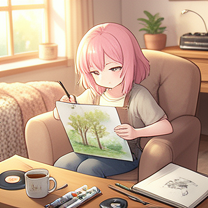
My German Adventure: Finding My Flow – Hobbies & Getting it Right
Okay, deep breaths. It’s been six months since I moved to Munich, and honestly, “learning German” feels less like studying and more like… trying to build a house with LEGOs sometimes. It’s amazing, frustrating, and I’m slowly starting to feel like I’m actually doing it, not just reading about it. Today, I want to talk about something super practical: talking about what I like to do, my hobbies, because that’s what people actually do when they meet.
The First Conversation – “Was machst du gern?”
I had my first real conversation about this with my colleague, Markus, at the office. We were grabbing coffee after a particularly stressful meeting. He asked me, “Was machst du gern?” (What do you like to do?). I panicked a little. I’d been practicing “Ich lese gern” (I like to read) but suddenly, that felt incredibly stiff.
I blurted out, “Ich lese gern… und… ich schlafe gern.” (I like to read… and… I like to sleep.) It sounded ridiculously basic, even to me. Markus chuckled, a friendly, genuine chuckle, and said, “Okay, gut! Aber… es gibt doch noch andere Dinge, nicht wahr? What about sports? Musik?” (Okay, good! But… there are still other things, right? What about sports? Music?)
That’s when I realised it wasn’t just about saying the right words. It was about the way you say them, and what you offer as an answer.
Modal Verbs – “Können,” “Müssen,” and “Sollen”
Markus’s question really highlighted the importance of modal verbs. They’re key to expressing ability, obligation, and advice, and they’re used constantly in German conversations.
- Können (can/to be able to): “Kannst du schwimmen?” (Can you swim?) I’d been so worried about swimming I hadn’t actually asked anyone. It’s something I’d like to try, so I’m working on it.
- Müssen (must/have to): “Muss ich hier warten?” (Do I have to wait here?) A helpful phrase when you’re feeling overwhelmed. I used it yesterday when I was trying to navigate the U-Bahn during rush hour.
- Sollen (should/ought to): “Soll ich dir helfen?” (Should I help you?) – My boss, Frau Schmidt, often uses this when she asks if I can take something on.
Separable Verbs – A Sticky Point!
Okay, this is where I really struggled. Separable verbs are verbs where a prefix separates from the main verb and goes to the end of the sentence. It’s incredibly common, and suddenly, I was hearing phrases like “Ich mache meine Wohnung sauber.” (I clean my apartment). I was confused because “machen” normally means “to do”.
I asked my language partner, Lena, about it. She patiently explained, “It’s like this: the prefix is just moving to the end. You have to learn them in context.” She gave me some examples: “Er nimmt das Buch mit.” (He takes the book with him). “Sie legt das Messer weg.” (She puts the knife away).
I made a huge mistake and tried to say, “Ich sauber mache meine Wohnung.” Lena nearly choked on her Apfelschorle (apple juice)! She gently corrected me, “Nein, nein! ‘Ich mache meine Wohnung sauber’ is correct.”
Talking About Hobbies – Practical Phrases
Here are some phrases I’ve been practicing:
- “Ich interessiere mich für…” (I’m interested in…) – “Ich interessiere mich für Fotografie.” (I’m interested in photography.)
- “Ich gehe gerne…” (I like to…) – “Ich gehe gerne wandern.” (I like to hike.)
- “Ich spiele…” (I play…) – “Ich spiele Gitarre.” (I play guitar.) – I’m terrible at it, but it’s fun!
- “Am Wochenende mache ich…” (On the weekend, I do…) – “Am Wochenende mache ich Radfahren.” (On the weekend, I go cycling.)
A Real-Life Scenario – Meeting New People
Yesterday, I went to a “Meetup” group for expats – a great idea! I was introduced to a man named Steven, who was also learning German. We started talking about our hobbies. I cautiously mentioned I enjoy cooking, and he immediately asked, “Was kochen Sie gern?” (What do you like to cook?). I stumbled a bit, saying, “Ich koche manchmal italienische Pasta” (I sometimes cook Italian pasta). He then added, “Das klingt lecker!” (That sounds delicious!)
That small exchange, that genuine interest, made me feel so much more comfortable. It wasn’t about perfect grammar; it was about connecting.
My Takeaway – Don’t Be Afraid to Mess Up!
Learning German, especially when it comes to everyday conversations, is a process of making mistakes. I’m still making them – lots of them! But I’m trying to embrace the awkwardness, laugh at myself, and keep practicing. Talking about my hobbies isn’t just about filling a gap in a conversation; it’s about showing people a little bit of who I am. And honestly, it’s making the whole learning process feel a little bit more… real. Ich glaube es! (I believe it!)
—
Would you like me to generate another section focusing on a specific aspect of this topic, such as specific German food vocabulary related to hobbies, or a deeper dive into a particular grammatical point?

Leave a Reply