
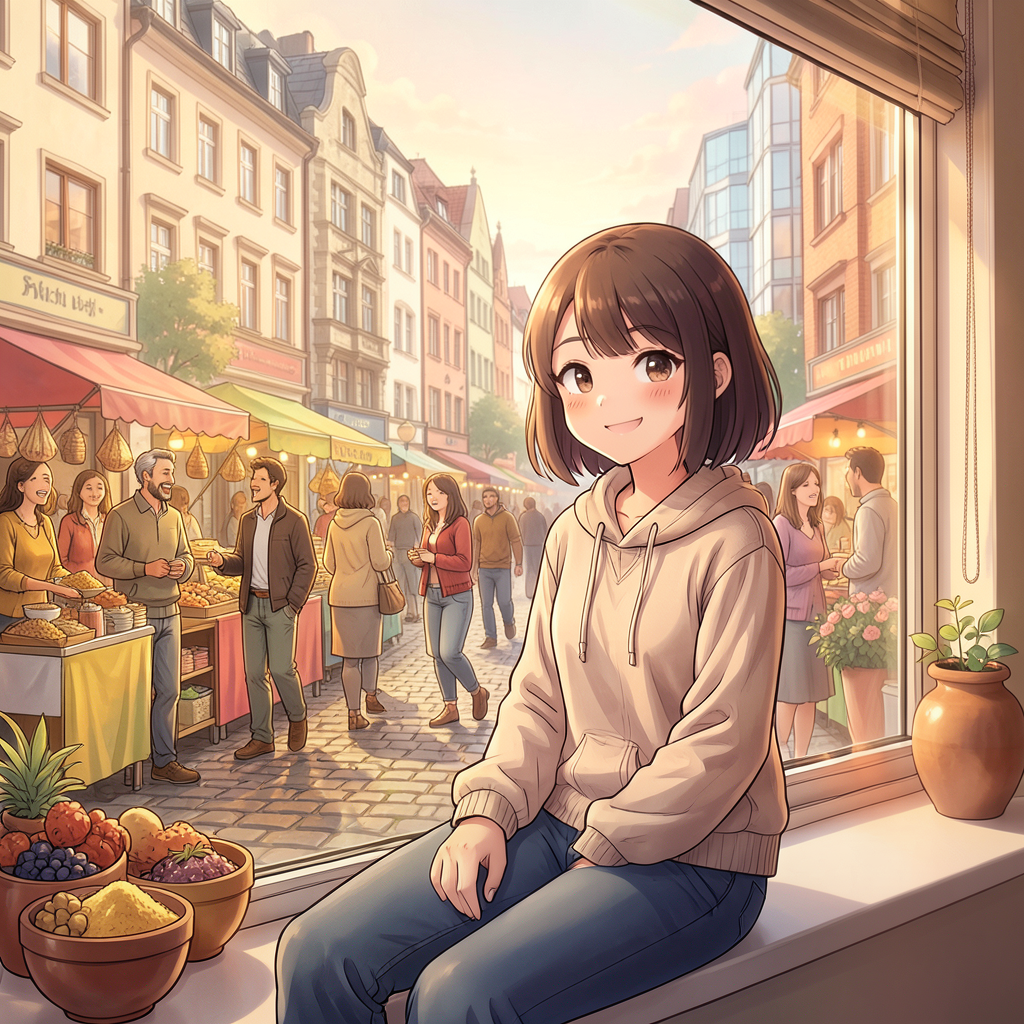
Navigating the Rainbow: My German Journey Through a Multicultural Germany
Okay, so here I am, nearly a year into living in Berlin, and let me tell you, learning German has been way more than just learning a language. It’s been about understanding this incredible, complex, and sometimes overwhelming city – and the people who live here. I came over for a job, a pretty good one actually, but honestly, before I even started seriously tackling Deutsch, I felt completely lost. It wasn’t just the grammar – though, gott sei dank, I’ve been taking classes – it was understanding how people communicated. And that’s where the real learning began, thanks to Germany’s amazing diversity.
First Impressions: “Entschuldigung, sprechen Sie Englisch?”
My first few weeks were a blur of “Entschuldigung, sprechen Sie Englisch?” pretty much every single time I tried to buy groceries or ask for directions. It was exhausting! I quickly realised that assuming everyone spoke English was, well, a massive assumption. I learned that phrase so many times, it’s practically burned into my brain. I also learned that a polite “Bitte” (please) goes a long way, no matter what language you’re using.
I had this hilarious moment in a Turkish bakery near my apartment. I was trying to order Simit (that sesame ring bread) and I completely butchered the pronunciation. The baker, a lovely older man named Mehmet, just smiled, repeated the word slowly, and said, “Simit? Ja, Simit!” It was a simple exchange, but it was a perfect example of the patience and willingness to help that I’ve encountered everywhere.
Hearing Different Voices – The Language of Neighborhoods
The real shift happened when I started spending time in different neighborhoods. Kreuzberg is a huge mix of Turkish, Arab, and various European cultures. I’d be walking down the street and hear conversations in Turkish, Arabic, Spanish, and Romanian all mixed together. It was incredible, and honestly, a little intimidating at first.
I heard a group of teenagers arguing in Arabic, gesturing wildly. I didn’t understand a word, but I saw one of them point at a shop and say, “Das ist zu teuer!” (That’s too expensive!). I quickly realised that even if you don’t understand the language, you can pick up on the gist of the situation.
I started trying to pick up useful phrases. I learned:
- “Guten Tag!” – Good day! (Always a good start)
- “Wie geht es Ihnen?” – How are you? (Formal, but useful)
- “Ich verstehe nicht.” – I don’t understand. (Essential!)
Misunderstandings and Laughing It Off
Of course, there were misunderstandings. There was one time I was trying to order coffee in a small café in a predominantly Syrian neighbourhood, and I accidentally asked for “eine große Milch mit Zucker” (a large milk with sugar). The barista, a young man named Omar, just stared at me, completely bewildered! I quickly realized I’d accidentally used a phrase I’d learned from a German travel guide – a phrase that definitely doesn’t belong in a Syrian coffee shop! He burst out laughing, explained that they just put sugar in the coffee themselves, and I felt incredibly silly. It was a great reminder that context and knowing the local customs are just as important as knowing the language.
“Danke!” – More Than Just ‘Thank You’
I’ve noticed that “Danke” (thank you) seems to carry a different weight here. It’s not just a polite phrase; it feels genuinely appreciated. I’ve received countless smiles and even small gestures of kindness – a shopkeeper offering me a sample of cheese, a neighbour helping me carry groceries. It’s made me feel incredibly welcome.
I’ve also learned to respond with “Bitte” (you’re welcome) – even if I don’t fully understand why they’re thanking me. It feels like a way of acknowledging their goodwill.
My German is Slowly Coming Together – And So Is My Understanding
I’m still far from fluent, but my German is improving every day. More importantly, my understanding of this diverse society is growing too. I’m learning to listen more than I speak, to observe more than I assume, and to embrace the beautiful chaos of a multicultural city. It’s a challenging journey, but it’s also incredibly rewarding. Ich lerne Deutsch und ich lerne Deutschland! (I’m learning German and I’m learning Germany!)
If you’re considering moving to Germany, I highly recommend diving into the diversity. Don’t be afraid to make mistakes, to ask questions, and to step outside your comfort zone. You’ll be surprised at how much you learn – not just about the language, but about yourself and the world.

Leave a Reply