
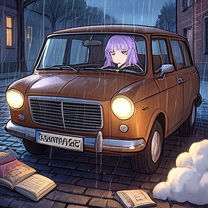
My First Week: Describing Vehicles in Germany – And Almost Getting Arrested
Okay, so, let me start by saying this has been… intense. Moving to Berlin for my new job as a translator felt like stepping into a film. But the initial excitement of exploring quickly hit a wall – the language! It’s everywhere. And today, I learned a really important skill, probably the most practical I’ve picked up so far: describing a car. Specifically, the car.
The Situation: A Very Confused Police Officer
It started, predictably, with a misunderstanding. I was walking back from a late meeting (don’t ask), and I saw a dark blue car parked a little too close to a fire hydrant. I wanted to politely ask the driver to move it. I’d been practicing my German all week, and I thought I was getting the hang of it.
“Entschuldigen Sie, Sie dürfen hier nicht parken!” I said, feeling pretty confident.
The driver, a very serious-looking man in his late 40s, looked at me with this completely baffled expression. He responded, “Was? Warum?”
I repeated, a little louder this time, “Ich bitte Sie, Sie parken hier nicht! Es ist verboten!” (I’m asking you, you are not parking here! It’s forbidden!)
He just stared. And then, another officer arrived. The whole situation escalated. Turns out, I’d completely butchered the phrasing and, without realizing it, described the car in a way that sounded… suspicious.
Compound Nouns – The Root of the Problem
That’s when I realized the key to this whole thing wasn’t just saying individual words. It was the compound nouns. I’d been so focused on translating “dark blue” as “dunkelblau” – which is correct – that I hadn’t considered how Germans naturally combine words.
The officer kept asking, “Was für ein Fahrzeug ist das?” (What kind of vehicle is that?). I confidently answered, “Es ist ein Blaulichtfahrzeug!” (It’s a police vehicle!)
Big mistake. Blaulichtfahrzeug is a compound noun meaning “police car” – literally “blue light vehicle.” I had essentially described a police car. I immediately felt my face turn red.
Breaking Down the Vocabulary
Okay, deep breaths. Let’s talk about the actual words I should have been using. Here’s a breakdown of useful vocabulary:
- Farbe: Color (e.g., die rote Farbe – the red color)
- Fahrzeug: Vehicle (e.g., ein Auto, ein Motorrad, ein LKW) – basically car, motorbike, truck.
- Marke: Make (e.g., die Marke BMW, die Marke Mercedes)
- Kennzeichen: License plate (e.g., das Kennzeichen ABC 123) – This is crucial.
- Stimmung: Mood, feeling – good, bad, etc.
- Fahrstil: Driving style – aggressive, cautious, etc.
Realistic Dialogue Examples
Let’s try some more natural conversation. Let’s say I’m talking to a friend about a car I saw.
Me: “Ich habe gestern ein Auto gesehen. Es war dunkelblau. Die Marke war ein Volkswagen. Und das Kennzeichen war XYZ 789.” (I saw a car yesterday. It was dark blue. The make was a Volkswagen. And the license plate was XYZ 789.)
Friend: “Ah, ein VW! Das ist gut. Ist es ein Kombi?” (Ah, a VW! That’s good. Is it a estate?) – Kombi is German for estate/station wagon.
Me: “Nein, es war ein Hatchback.” (No, it was a hatchback.)
Practicing with Different Colors
I’ve been trying to practice describing colors. Rot is red, obviously. Gelb is yellow. Grün is green. And then there’s dunkel – which means dark.
So, “ein dunkelgrünes Auto” (a dark green car) is perfectly normal. But “ein hellblaues Auto” (a light blue car) sounds a little strange.
My Biggest Mistake – And How I Learned From It
The biggest thing I’m realizing is that I need to listen more than I speak, especially at first. I was so eager to demonstrate my German that I didn’t properly gauge the context. The officer wasn’t just asking about the color; he was asking about the type of vehicle.
I’ve made a note to myself – and to my German language app – to focus on understanding the nuances of how Germans combine words. It’s a small detail, but it makes a huge difference in avoiding awkward, and potentially alarming, conversations with the police!
Now, if you’ll excuse me, I’m going to go practice describing my bike. Hopefully, I won’t accidentally declare it a “blauer Lichtfahrzeug.”

Leave a Reply