
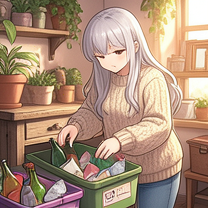
My Journey into ‘Grünes Denken’ – Learning German Through Recycling
Okay, so here I am, six months in Berlin, and let’s be honest, the first few months were… chaotic. I’d moved here for a job as a software developer, which is great, but the culture shock was real. It wasn’t just the language, though that was a beast, it was everything. The way people thought about things, particularly when it came to the environment. It’s called ‘Grünes Denken’ – Green Thinking – and it’s a big deal here. And I quickly realised, to really integrate and actually understand what everyone was talking about, I needed to learn the language.
The Recycling System – A Confusing Start
The first thing I encountered was the recycling system. It’s… intricate. You’ve got ‘Gelbe Tonne’ (Yellow Bin) for plastics and cartons, ‘Blaue Tonne’ (Blue Bin) for paper, and ‘Grüne Tonne’ (Green Bin) for garden waste. Then there’s the ‘Restmülltonne’ (Residual Waste Bin) for everything else. The first time I went to the depot, I just dumped everything in the blue bin, figuring it was all recyclable. The woman sorting through the bins – she was incredibly polite, but her face! – she said, very patiently in German, “Nein, nein, nein! Das Papier muss in die Blaue Tonne! Die Plastikflaschen in die Gelbe Tonne! Sonst wird alles weggeworfen!” (No, no, no! The paper must go into the Blue Bin! The plastic bottles into the Yellow Bin! Otherwise, everything gets thrown away!). I felt so stupid.
I started practicing the phrases: “Was gehört in welche Tonne?” (What goes into which bin?), “Ich bin neu hier, ich verstehe nicht alles.” (I’m new here, I don’t understand everything.) It’s amazing how much a simple ‘Entschuldigung, ich lerne Deutsch’ (Excuse me, I’m learning German) can do.
Modal Verbs – ‘Müssen’ and ‘Sollen’ in Action
Learning about recycling also forced me to really grapple with modal verbs. You hear people say things like “Wir müssen mehr recyceln!” (We must recycle more!) and “Wir sollen unsere Ressourcen schonen!” (We should conserve our resources!). ‘Müssen’ means ‘must’ – a strong obligation. ‘Sollen’ is more like ‘should’ – a recommendation or advice. I kept getting confused, trying to translate it perfectly, but I realised it’s about understanding the nuance of what people are saying. A colleague, Klaus, explained it to me: “Müssen ist wie ein Befehl, Sollen ist eher eine Empfehlung.” (Must is like an order, Should is more of a recommendation).
Passive Basics – ‘Wird…’ and the Recycling Process
The conversations around recycling also introduced me to the basics of the passive voice. You hear things like “Die Mülltonnen werden geleert” (The bins are emptied) and “Das Papier wird recycelt” (The paper is recycled). It’s a slightly confusing concept for a beginner, but I realised it’s about describing the action without focusing on who’s doing it. I asked my supervisor, Alice, “Warum sagen Sie ‘wird recycelt’?” (Why do you say ‘is recycled’?) and she explained that it’s common in describing processes, like “Die Plastikflaschen werden zu neuen Produkten gemacht” (The plastic bottles are made into new products).
It felt a little abstract at first, but I’m starting to get a better feel for it.
Real-Life Scenarios – The ‘Selbstversorgung’ Movement
One thing I’ve noticed is the growing interest in ‘Selbstversorgung’ – self-sufficiency. People are talking about growing their own vegetables, buying local produce, and reducing their waste. I met a group of people at a farmers’ market – they were selling organic vegetables and explaining how they compost everything. One of them, a woman named Ingrid, was explaining the composting process: “Die organische Abfall wird zerkleinert und dann mit Wasser vermischt, um Kompost zu bilden.” (Organic waste is crushed and then mixed with water to form compost). It’s a really different way of thinking about food and waste. I’m considering starting a small herb garden on my balcony – a tiny step towards ‘Selbstversorgung’!
Small Mistakes, Big Learning
I’ve definitely made mistakes. I accidentally put a plastic bag in the blue bin (again!), and I had to sheepishly apologise to the bin sorter. I also tried to explain my approach to recycling to a group of friends – I got completely lost in a detailed explanation about the different types of plastics and the importance of reducing waste. They just smiled and said, “Das ist ja kompliziert!” (That’s complicated!). It’s a reminder to keep practicing, keep asking questions, and to not be afraid to make mistakes.
Looking Ahead – “Grünes Denken” and a Sustainable Future
Learning German and understanding ‘Grünes Denken’ is helping me to feel more connected to this country and its values. It’s not just about learning a new language; it’s about adopting a new way of thinking. I’m still a long way from being fluent, but I’m committed to continuing my journey – one recycled bin at a time. Ich glaube, wir können etwas bewirken! (I believe we can make a difference!).

Leave a Reply