
My German Bike Adventure: Paths, Pads, and “Darf Ich”?
Okay, so here I am, a few months into living in Heidelberg, and let me tell you, my life has taken a serious turn – a two-wheeled, wind-in-my-hair turn. I’ve always wanted to cycle, but the thought of actually doing it here, in Germany, was terrifying. I was convinced I’d end up in a spectacular pile of pavement. But then, I decided to just do it, and it’s been… well, it’s been an adventure. And, thankfully, learning German is proving to be surprisingly helpful.
Navigating the Radwegen: Bike Paths and Basic Phrases
The first thing I realised was that everyone rides bikes here. Seriously. And not just for sport. It’s how people get around! The Radwege – the bike paths – are fantastic. They’re so well-maintained, and they actually seem to want you to be there. The problem was, I kept trying to figure out the signage, and it felt incredibly overwhelming at first.
I quickly learned a few key phrases. “Wo ist der Radweg?” (Where is the bike path?) is essential. I asked a friendly woman with a basket full of flowers near the Alte Brücke (Old Bridge) and she pointed me towards the Neckar-Radweg, a beautiful path that runs along the river. She said, “Ach, den kennst du doch! Einfach geradeaus!” (Oh, you know it! Just straight ahead!). That was a huge relief.
Another common one is “Entschuldigung, darf ich hier links/rechts überholen?” (Excuse me, may I overtake here to the left/right?). I used it the other day when I was struggling to keep pace with a cyclist who looked incredibly confident. I nearly panicked before I realized it was the polite way to do it.
Safety First: Equipment and Asking for Help
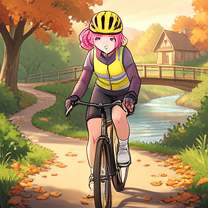
Of course, cycling isn’t just about the paths. I needed to get the right equipment. I went to a local Sportgeschäft (sport shop) and was completely lost. Everything looked so…technical. The shop assistant, a guy named Klaus, was incredibly patient. I asked him, “Was brauche ich für einen Anfänger?” (What do I need as a beginner?) and he recommended a helmet ( Helm), lights ( Lichter), and reflective clothing. I felt incredibly silly wearing a bright yellow jacket, but he explained, “Das ist sehr wichtig, besonders abends!” (That’s very important, especially in the evenings!).
I also learned a really important phrase: “Ich habe einen Platten!” (I have a flat tire!). I had a truly awful experience a few days later, a puncture right in the middle of the city. A kindly older gentleman, Herr Schmidt, saw me struggling and stopped to help. He said, “Kein Problem, ich helfe Ihnen.” (No problem, I’ll help you.) He even gave me a few tips on how to change the tire – a seriously valuable lesson.
Modal Verbs: “Darf”, “Kann”, and “Muss” in Cycling Situations
This is where German started to really click for me, especially when it came to situations like cycling. The modal verbs – dürfen (to be allowed to), können (to be able to), and müssen (to have to) – are used constantly.
- Darf ich…? (May I…?) – This is crucial for navigating bike paths and overtaking. I’ve already used it countless times. “Darf ich hier links überholen?” (May I overtake here to the left?) – asking before doing it is so important, and Germans seem to take it very seriously.
- Kann ich…? (Can I…?) – This is for asking about abilities, like “Kann ich hier parken?” (Can I park here?).
- Muss ich…? (Must I…?) – I encountered this when a sign said “Radfahrer müssen hier anhalten” (Cyclists must stop here). It felt a bit stern, but I understood the rule.
A recent conversation perfectly illustrated this. I was trying to cycle alongside a group of older men on a particularly busy path. One of them, a man named Dieter, shouted to me, “Pass auf! Du musst hier links halten!” (Be careful! You must turn left here!). I felt a bit flustered, but it made total sense.
Small Mistakes, Big Lessons
I’ve definitely had my awkward moments. Once, I misread a sign and ended up going the wrong way on a bike path – completely baffling Klaus who was cycling alongside me. He just laughed and said, “Ach, das passiert!” (Oh, that happens!). I learned to always double-check signage and to not be afraid to ask for directions.
Learning German while cycling has been a fantastic combination. It’s improved my confidence, helped me understand the culture, and, most importantly, has made exploring Heidelberg a much richer experience. It’s not always smooth, and there are definitely moments of frustration (like that puncture!), but every small victory – every successfully navigated Radweg, every politely asked “Darf ich…?” – feels amazing. Next time, I’m aiming to cycle to the Gutenberg Museum – wish me luck!

Leave a Reply