
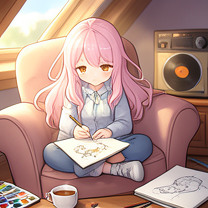
My First Steps into Talking About Hobbies in Germany
Okay, deep breaths. It’s been six months since I moved to Berlin, and honestly, the initial overwhelm is mostly gone. I’m getting by, I’m finding a job as a translator (yay!), and I’m slowly building a life. But there’s still this persistent little voice whispering, “You can’t just translate. You need to connect.” And a big part of that, I realized, is talking about what I enjoy. It’s terrifying, of course. I’m not exactly known for my outgoing personality back home. But I’m starting to understand that Germans, despite their reputation for being direct, actually want to know about your interests.
The Initial Stumble: “Ich bin ein…was?”
The first few times I tried to mention my hobbies, it was a disaster. I was telling a colleague, Steven, that I liked to paint, and I blurted out, “Ich bin ein…Künstler!” (I am an…artist!). He looked at me with this incredibly polite, slightly confused expression. Then his colleague, Lisa, gently corrected me. “Nein, nein, Steven says it’s good to talk about hobbies, but ‘Ich male’ is better. ‘Ich male Bilder’ is even better. It’s more natural.” I felt my face burn. “Ich male” felt so forced. “Ich male Bilder” felt…right. It’s a small thing, but it highlighted the whole awkwardness of trying to express myself in a new language.
- Vocabulary Tip: “Ich male” – I paint. “Ich male Bilder” – I paint pictures. “Ich interessiere mich für…” – I’m interested in…
Talking About Creative Pursuits: The Right Phrases
So, I started researching. I found a great little website with common phrases to use when talking about hobbies in German. It helped immensely. I learned that just saying “Ich mache…” (I do…) isn’t always enough. You need to specify what you do.
For example, I’m trying to talk about my writing – I’m working on a short story. I’d heard you say “Ich schreibe” (I write) is correct, but “Ich schreibe eine Geschichte” (I write a story) sounds more natural and shows you’re being specific. I used it with my language partner, Alice, last week, and she gave me such encouraging feedback!
Dialogue Example:
Me: “Ich schreibe eine Kurzgeschichte. Sie ist sehr schwierig!” (I’m writing a short story. It’s very difficult!)
Alice: “Oh, das ist toll! Was für eine Geschichte?” (Oh, that’s great! What kind of story?)
My Hobby Group – “Kreativ-Club”
I decided to join a local “Kreativ-Club” – a creative club. It’s held in a community center in Prenzlauer Berg. It’s amazing! Everyone’s so friendly, and it’s really helped me to feel more comfortable talking about my interests. There’s a painter, a sculptor, a potter, and even someone who makes jewelry.
Last week, I told a woman named Susan about my painting. I managed to say, “Ich male, aber ich bin noch Anfänger.” (I paint, but I’m still a beginner.) She smiled and said, “Das ist gut! Vielleicht können wir zusammen malen.” (That’s good! Maybe we can paint together.) It was a huge step for me.
Phrases to Use:
- “Ich bin ein Anfänger/eine Anfängerin” – I’m a beginner.
- “Ich interessiere mich für…” – I’m interested in…
- “Ich habe ein Hobby…” – I have a hobby…
- “Es macht mir Spaß…” – It’s fun for me…
Common Misunderstandings and How to Handle Them
Here’s a tricky one I ran into. I was telling someone about my photography, and I used the word “Foto” (photo). They looked utterly bewildered. Turns out, “Foto” is more like a service – a professional photographer. You need to use “Fotos machen” (to take photos). It’s easy to mix these up!
I had to laugh at myself. It’s a constant learning process, and I’m realizing that even native speakers make mistakes. The important thing is that I’m trying, and I’m getting better.
- Key Difference: “Foto” = Photo (a single image). “Fotos machen” = To take photos.
Moving Forward – Be Brave, Be Honest
The biggest takeaway so far? Don’t be afraid to make mistakes! Germans are generally very understanding and appreciate the effort. Start small, use the phrases you’ve learned, and honestly express your interests. Even if you stumble, it’s a chance to learn and connect. Ich glaube an dich! (I believe in you!) Now, I’m off to find some more paints… vielleicht mit Susan! (Maybe with Susan!)

Leave a Reply