
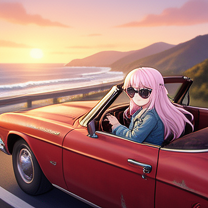
Road Trips and German: My Adventures in Conversation
Okay, so I’ve been living in Berlin for nearly three years now, and honestly, I still feel like I’m constantly learning. It’s not just the German itself, although that’s a huge part of it. It’s learning how Germans talk, when they talk, and how to navigate those conversations, especially when things get tricky. And lately, I’ve been thinking a lot about road trips, which has unexpectedly become a fantastic way to brush up on my conversational German.
The Dream – And the Initial Confusion
I’ve always wanted to do a proper road trip across Germany, Austria, and maybe even a little bit of Switzerland. The idea of driving through the Bavarian Alps, or along the Romantic Road, just… it feels amazing. But before I could even start planning, I realized I needed to get better at talking about it. I started picturing myself asking for directions, booking accommodation, even just ordering a coffee at a roadside café. The thought made me nervous, and I knew I needed to practice.
First Attempts: “Ich fahre…” (I’m Driving…)
My first attempt involved telling my colleague, Thomas, about my plans. I was so excited! I said, “Ich fahre mit dem Auto in den Urlaub!” (I’m driving with the car on vacation!). Thomas looked at me, completely puzzled. He said, “Aber… wo willst du fahren?” (But… where do you want to go?).
I realized I hadn’t actually said where I wanted to go. I’d just announced my intention to drive. It was a pretty basic mistake, but it highlighted how important it is to give context. The correct way to say it would have been, “Ich fahre mit dem Auto in den Urlaub, vielleicht nach München!” (I’m driving with the car on vacation, maybe to Munich!). Adding details is key.
Vocabulary for the Open Road
Over the next few weeks, I started focusing on specific vocabulary related to travel. Here are some phrases that have become super useful:
- Die Navigation: (The Navigation) – “Ich habe die Navigation eingerichtet.” (I’ve set up the navigation)
- Die Unterkunft: (The Accommodation) – “Wir suchen eine Unterkunft für die Nacht.” (We’re looking for accommodation for the night.) – I’ve learned that asking for “eine einfache Unterkunft” (a simple accommodation) usually gets you a good, reasonably priced place.
- Die Tankstelle: (The Gas Station) – “Ich muss an der nächsten Tankstelle tanken.” (I need to fill up at the next gas station). It’s pretty standard to say this when you’re a little low on fuel.
- Die Piste: (The Road) – “Bitte, halten Sie sich an der Piste.” (Please, stay on the road). I’ve heard this a few times from drivers, and it’s surprisingly common!
- Ist es weit? (Is it far?) – Absolutely essential when asking for directions.
Asking for Directions – A Hilarious Mishap
Okay, this is where things got really interesting. I was driving through Bavaria, trying to find a small village called Rothenburg ob der Tauber, and I needed to ask for directions. I approached a farmer who looked incredibly friendly. I started with, “Entschuldigen Sie, könnten Sie mir sagen, wie ich nach Rothenburg komme?” (Excuse me, could you tell me how to get to Rothenburg?).
He looked at me blankly and responded with, “Rothenburg? Das ist doch eine Touristenfalle!” (Rothenburg? That’s a tourist trap!). I was completely thrown! I had no idea what he was talking about. It turns out, he was just warning me about the crowds and the inflated prices. It was a valuable lesson – Germans can be quite direct, and sometimes they’re offering a genuine opinion, even if it’s a slightly blunt one. I quickly learned to respond with, “Vielleicht, aber ich möchte es trotzdem sehen!” (Maybe, but I still want to see it!).
Small Talk & Road Trip Chat
It’s not just about directions, though. I’ve found that even small talk about road trips opens up a lot of conversation. For instance, last week, I stopped at a roadside café and asked the waitress, “Wie ist das Wetter dort?” (How is the weather there?) – referring to my destination. She told me it was raining heavily in the Alps and offered me a Kaffee und Kuchen (coffee and cake) to help me cope with the gloomy weather. That simple exchange felt really authentic.
The Biggest Takeaway: Be Prepared and Don’t Be Afraid to Make Mistakes
My road trip conversations in German have taught me a few crucial things:
- Preparation is key. Learning basic phrases and vocabulary beforehand dramatically reduces the stress of the moment.
- Don’t be afraid of mistakes. Seriously, everyone makes them! Germans are generally very understanding and appreciate the effort.
- Listen carefully and observe. Pay attention to how people actually speak, not just what you read in a textbook.
I’m still a long way from fluent, but every conversation about road trips is a victory. Now, I just need to start planning that actual road trip! Ich wünsche Ihnen eine gute Reise! (I wish you a good trip!)

Leave a Reply